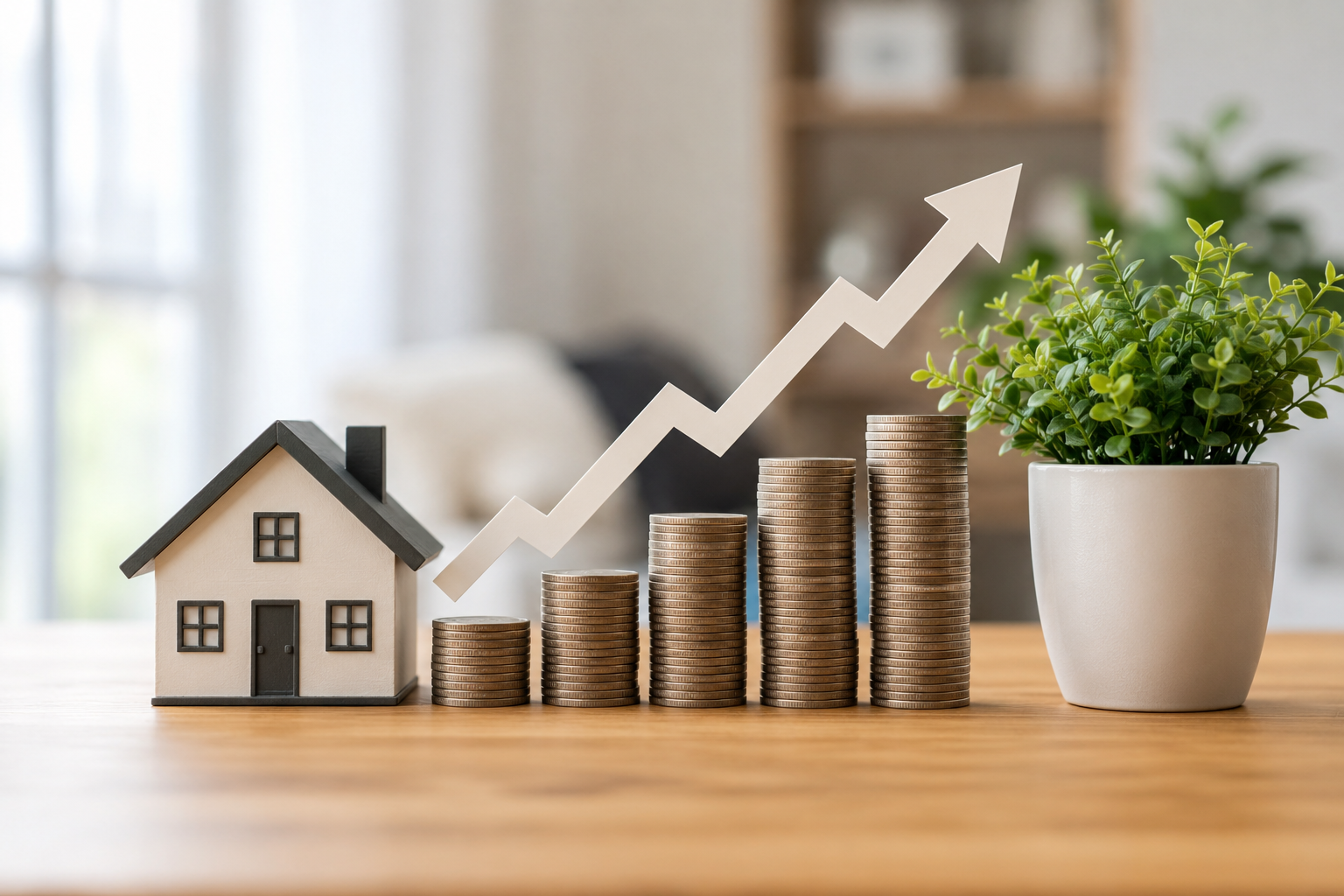
One of the biggest financial benefits of owning a home is building equity.
Equity is the difference between what your home is worth and what you still owe on it.
For example, if your home is worth $350,000 and you owe $250,000 on your mortgage, you have about $100,000 in equity before considering selling costs, liens, or other expenses.
Equity matters because it can give you more options.
It may help you sell and walk away with proceeds. It may help you refinance. It may give you borrowing power through a home equity loan or HELOC. It may help you buy your next home. And over time, it can become one of the biggest pieces of your financial picture.
The good news is that equity does not only build by accident.
There are practical ways to build equity faster if you are intentional.
What Is Home Equity?
Home equity is the portion of the home’s value that belongs to you after subtracting what you owe.
The basic formula is:
Home Value - Mortgage Balance = Home Equity
If your home increases in value, your equity can increase.
If you pay down your mortgage, your equity can increase.
If both happen at the same time, your equity can grow faster.
That is one of the reasons homeownership can be powerful over the long term.
You are not just making a housing payment. Part of your payment may be reducing the principal balance on your loan, which helps build ownership in the property.
Why Equity Matters
Equity can create flexibility.
When you have more equity, you may have more options.
Equity can help when you want to:
Sell and buy another home
Refinance
Remove PMI if eligible
Use a home equity loan or HELOC
Renovate or improve the property
Consolidate debt, if appropriate
Build long-term net worth
Create more financial security
Have more negotiating power when selling
Equity is not the same as cash in your bank account.
You usually cannot access it without selling, refinancing, or borrowing against the home.
But it is still a major financial asset.
How Equity Builds Naturally
Equity usually builds in two main ways.
1. Paying Down the Mortgage
Each mortgage payment is usually split between principal and interest.
The principal portion reduces what you owe.
The interest portion is the cost of borrowing money.
At the beginning of many mortgage loans, more of the payment goes toward interest and less goes toward principal. Over time, that changes, and more of your payment goes toward principal.
That means equity often builds slowly at first and faster later in the loan.
2. Appreciation
Appreciation is when your home increases in value over time.
This can happen because of:
Market demand
Low inventory
Location
Neighborhood growth
Improvements to the property
Inflation
Buyer competition
Local job growth
School district demand
Condition and maintenance
Appreciation is powerful, but it is not guaranteed.
Markets can rise, flatten, or fall.
That is why the parts you can control matter.
1. Make Extra Principal Payments
One of the simplest ways to build equity faster is to pay extra toward principal.
Even a small additional amount can reduce your loan balance faster over time.
Examples may include:
Paying an extra $50 or $100 per month
Rounding up your mortgage payment
Making one extra payment per year
Applying a bonus or tax refund to principal
Making occasional lump-sum payments
Setting up biweekly payments if your lender handles them correctly
The important detail is that extra money should be applied to principal.
Do not assume the lender will automatically apply it the way you intend.
When making extra payments, confirm:
The extra payment goes to principal
There is no prepayment penalty
The payment does not simply advance your next due date
Your loan servicer applies it correctly
Extra principal payments can help reduce the balance faster, which builds equity and may reduce total interest paid over the life of the loan.
2. Choose a Shorter Loan Term
A shorter loan term can build equity faster.
For example, a 15-year mortgage usually builds equity faster than a 30-year mortgage because more of each payment goes toward principal, and the loan is paid down over a shorter period.
The tradeoff is that the monthly payment is usually higher.
A shorter loan term may make sense if:
You have stable income
You can comfortably afford the higher payment
You want to pay the home off faster
You want to reduce total interest
You are not stretching your budget too thin
You still have money for emergencies and maintenance
A shorter loan term is not automatically better for every buyer.
If the higher payment leaves you house-poor, it may create stress.
The best loan structure should fit your full financial life.
3. Make a Larger Down Payment
The more money you put down when buying, the more equity you start with.
For example, a buyer who puts 20% down starts with more equity than a buyer who puts 3% down.
A larger down payment may also help you:
Avoid PMI on some conventional loans
Lower your monthly payment
Reduce total interest paid
Strengthen your offer
Create a better equity position from day one
But there is a tradeoff.
Using all your cash for a larger down payment may leave you with less money for repairs, furniture, moving costs, emergencies, or future opportunities.
The goal is not always to put every dollar into the house.
The goal is to balance equity, monthly payment, and cash reserves.
4. Buy Below Your Maximum Budget
One underrated way to build equity faster is buying below your maximum approval amount.
Just because a lender approves you for a certain price does not mean you need to spend that full amount.
Buying below your max can give you more room for:
Extra principal payments
Improvements
Maintenance
Emergency savings
Future investing
Lower stress
More flexibility
If your payment is comfortable, you may have more ability to pay extra toward principal or improve the property over time.
Buying the most expensive home you qualify for can limit those options.
5. Improve the Property Strategically
Home improvements can help increase value, which may increase equity.
But not all improvements create the same return.
Some projects make a home more valuable.
Some make it more enjoyable.
Some do both.
Strong equity-building improvements may include:
Improving curb appeal
Updating kitchens carefully
Updating bathrooms carefully
Replacing worn flooring
Painting
Improving lighting
Fixing deferred maintenance
Improving energy efficiency
Finishing usable space when appropriate
Replacing old systems when needed
Improving outdoor living areas
The key word is strategically.
Spending $80,000 on a project does not automatically add $80,000 in value.
Before making major improvements, think about the local market, price point, neighborhood, buyer expectations, and resale value.
6. Take Care of Maintenance
Maintenance may not feel exciting, but it protects equity.
Deferred maintenance can hurt value.
Small problems can become expensive problems if ignored.
Examples include:
Cleaning gutters
Servicing HVAC systems
Maintaining the roof
Addressing water issues quickly
Keeping paint and caulk in good condition
Maintaining the septic system, if applicable
Testing and servicing the well system, if applicable
Fixing leaks promptly
Managing drainage around the foundation
Keeping landscaping under control
A well-maintained home usually shows better, inspects better, and sells with more confidence.
Protecting equity is just as important as building it.
7. Avoid Over-Improving for the Neighborhood
This is a major mistake homeowners make.
They assume any improvement adds value.
But if you improve far beyond what the neighborhood supports, you may not get the return you expect.
For example, putting luxury-level finishes into a starter-home neighborhood may make the home nicer, but the resale value may not increase enough to justify the cost.
The same can happen with additions, high-end kitchens, pools, specialty rooms, or highly personal finishes.
Before doing a major project, ask:
Will buyers in this area pay for this?
Is this improvement common for the neighborhood?
Does this solve a real resale issue?
Am I doing this for value, enjoyment, or both?
How long do I plan to stay?
Would this price me above the neighborhood ceiling?
Not every improvement needs to be about resale.
It is your home.
But if the goal is building equity, the numbers matter.
8. Remove PMI When Eligible
If you have private mortgage insurance on a conventional loan, removing it when eligible can improve your monthly payment.
Removing PMI does not directly increase your home’s value, but it can free up monthly cash that could be used for principal payments, savings, or improvements.
PMI rules depend on your loan, lender, equity position, payment history, and whether cancellation is based on original value or current value.
If you believe you may have enough equity, contact your loan servicer and ask:
When can I request PMI cancellation?
What loan-to-value ratio is required?
Is a new appraisal needed?
Are there seasoning requirements?
Do I need a strong payment history?
Are there fees?
What is the process?
Do not assume PMI disappears the moment you feel like you have 20% equity.
Ask directly.
9. Refinance Carefully
Refinancing can sometimes help build equity faster.
For example, refinancing to a shorter term may help you pay the loan down faster.
Refinancing to a lower interest rate may free up cash that can be applied toward principal.
But refinancing can also slow equity growth if you reset the loan term, roll closing costs into the loan, or pull cash out without a strong reason.
Before refinancing, ask:
What is my current rate?
What would the new rate be?
What are the closing costs?
Am I resetting the loan term?
Is my monthly payment going up or down?
Will I pay the loan off faster?
How long will I stay in the home?
What is the break-even point?
Am I borrowing more money?
Refinancing is not automatically good or bad.
It depends on the math.
10. Be Careful Borrowing Against Equity
Home equity loans and HELOCs can be useful tools.
They may help homeowners fund renovations, consolidate debt, or handle major expenses.
But borrowing against your equity reduces the equity available to you.
That can limit your options later if you want to sell, refinance, or buy another home.
Using equity for a smart, value-adding purpose may make sense.
Using equity for lifestyle spending, vacations, vehicles, or short-term wants can be risky.
Before borrowing against your home, ask:
What is the purpose of the money?
Will this improve my financial position?
Am I increasing the home’s value?
What is the interest rate?
What is the repayment plan?
How does this affect my ability to sell?
What happens if home values decline?
Am I putting my home at risk?
Equity is valuable.
Use it carefully.
11. Buy in the Right Location
Location affects equity.
A well-chosen location can support stronger resale value and long-term demand.
That does not mean you need to buy in the most expensive neighborhood.
It means you should think about what future buyers may value.
Location factors may include:
School district
Commute patterns
Access to jobs
Neighborhood condition
Property taxes
Public utilities
Road noise
Lot usability
Nearby amenities
Future development
Local demand
Resale history
A great house in a difficult location may appreciate differently than an average house in a highly desirable location.
You can improve a house.
You cannot move it.
12. Look for Sweat Equity Opportunities
Sweat equity means you create value by improving the home, often through work you manage or complete yourself.
This can be a powerful strategy for the right buyer.
Examples may include:
Painting
Landscaping
Cleaning
Removing old carpet
Updating fixtures
Improving curb appeal
Minor cosmetic updates
Organizing unfinished spaces
Basic repairs
Sweat equity works best when the home has good bones and the improvements are manageable.
It can be risky if the home needs major structural, electrical, plumbing, septic, mold, or foundation work that exceeds your skill level or budget.
The best sweat equity opportunities are often homes that other buyers overlook because they are dated, cluttered, poorly marketed, or cosmetically tired.
13. Keep Good Records
If you make improvements to your home, keep records.
Save:
Receipts
Contractor invoices
Permits
Before and after photos
Warranty documents
Product information
Maintenance records
Service records
These records can help when it is time to sell.
They can show buyers what work was done, when it was done, and who completed it.
Good records create confidence.
Confidence can help value.
14. Understand the Local Market
Equity is affected by the market.
A homeowner in Hanover may experience different equity growth than someone in another part of York County, Adams County, or Carroll County.
Local factors matter.
Those factors can include:
Inventory levels
Buyer demand
Interest rates
New construction supply
School district demand
Affordability
Employment trends
Property taxes
Condition of nearby homes
Comparable sales
If you want to understand your equity position, do not rely only on a national estimate.
Talk with someone who understands your local market and can compare your home to recent nearby sales.
15. Do Not Ignore Selling Costs
When thinking about equity, remember that equity is not always the same as net proceeds.
If your home is worth $350,000 and you owe $250,000, your rough equity may be $100,000.
But if you sell, there may be costs such as:
Mortgage payoff
Transfer tax
Brokerage fees
Seller concessions
Repairs
Title-related costs
Municipal requirements
Moving costs
Payoff fees
Other settlement costs
Your estimated net is what you may walk away with after selling expenses.
Equity is important, but net proceeds are what matter when you sell.
Common Mistakes That Slow Equity Growth
Here are a few common mistakes homeowners make:
Making only minimum payments when they could comfortably pay extra.
Spending all available cash upfront and having no repair reserve.
Ignoring maintenance.
Over-improving for the neighborhood.
Borrowing against equity for non-essential spending.
Refinancing without understanding the long-term math.
Letting small repairs become major repairs.
Choosing improvements based only on personal taste.
Assuming online value estimates are always accurate.
Forgetting that selling costs affect net proceeds.
Building equity is not about one big decision.
It is about making smart decisions consistently over time.
Fast Equity vs. Healthy Finances
Building equity faster is a good goal, but it should not come at the expense of your financial stability.
Before putting extra money toward the mortgage, consider whether you also need to:
Build an emergency fund
Pay off high-interest debt
Save for repairs
Save for retirement
Maintain cash reserves
Prepare for future life changes
Avoid becoming house-poor
A paid-down mortgage is great.
But cash flexibility matters too.
The best plan usually balances equity growth with overall financial health.
Final Thoughts
Building equity is one of the biggest benefits of homeownership.
You can build equity by paying down your mortgage, benefiting from appreciation, maintaining the home, making smart improvements, avoiding unnecessary debt against the property, and buying with a clear long-term plan.
But equity does not happen only because the market goes up.
The choices you make matter.
Buy wisely.
Maintain the home.
Improve strategically.
Pay down principal when it fits your budget.
Protect your cash reserves.
And understand your local market.
That is how you build equity faster and protect the value of your home over time.
Thinking About Buying or Want to Know Your Equity Position?
If you are thinking about buying a home in Hanover, York County, Adams County, Carroll County, or the surrounding areas, our team can help you think through the long-term equity picture before you buy.
And if you already own a home, we can help you understand what your home may be worth in today’s market, what you may owe, and what your estimated equity position could look like.
Equity is one of the most powerful parts of homeownership.
The right plan can help you build it with more confidence.
Check out this article next